Blog

  • The Vijay Times: Science and Magic – Strange Bedfellows

    The Vijay Times: Science and Magic – Strange Bedfellows

    By Vineeth S. November 19, 2003.
    ‘Science & Technology’, The Vijay Times

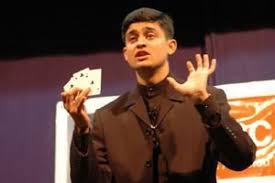
    NAKUL SHENOY saw his first magic show when he was five, and a life-long journey began from there. He perfected the art, and gave his first public show when he was 15. Now a well-known magician who has explored various facets of magic, he is a member of the International Broitherhood of Magicians, International Magicians’ Society and the World Alliance of Magicians.

    His interests now lie in Mental Magic, also known as Mentalism, which are demonstrations of seemingly psychic abilities. He also performs with the renowned illusionist Prahlad Acharya.

    He spoke to Vineeth S on how much a role science plays in magic.

    VS: In a show what per cent of the tricks are science-based, and what per cent rely on sleight of hand?

    NS: Every magic show is an attempt at appearing to prove some law of science wrong. For example, levitations is against the laws of gravity, and a man coming out of a very small box is against the laws of geometry, but a magician makes these happen. And to an audience, this seems like the impossiblebeing possible, and draws them to it. In a demonstration, to disprove one law of science another law of science is used. So, whatever trick it may be, whether a card trick of levitation, a magic show is science all the way. To answer that question in a word, 100 per cent.

    VS: Do explicitly science-driven tricks, like the burning of a coconut by sprinkling water, attract an audience more or do tricks like the card tricks attract an audience more?

    NS: Whether it is a scientific trick, or a trick by sleight of hand, it is the presentation of the magician which counts. It depends on how much the magician can get the audience involved, and control their attention. I could show you how to do a trick, but then if you try it on a audience, it might not be as impressive as a professional magician doing it. So even a simple trick can become the most impressive in a good performance. For example, in the hands of David Blaine, even the simplest of tricks seem like amazing wonders. Magic to a large degree is about perceptions, and the onus is on the magician to play with how things are perceived.

    VS: Since you say science and magic are inextricably linked how has their history together been?

    NS: I would venture as far as to say science has its origin in magic. The most important example is that of chemistry. In the medieval world, there was something known as Alchemy, which was an effort to turn lead into gold, and in fact any metal into gold. The science of chemistry began from the efforts in thisbart of magic, and then grew into a full-fledged science. Physics for example had a major presence in ancient Egypt at the Temple of Memphis, where voices spoke to pople who thronged to the temple, the doors seemed to open and close by themselves when people came or left. So, they have had quite a long journey together.

    VS: People explain any complicated magic trick as hypnosis or mass hypnosis. Is this true? How much of a show relies on hypnotism, like cutting a person in two?

    NS: There is absolutely no hypnotism in a magic performance. I am a practising hypnotist, and so I can say this with authority that mass hypnotism cannot be guaranteed. And so hypnotism per se cannot be used in a magic show. Even the cutting of a person example that you cite is not by hypnotism but by other methods. Yes, hypnotism can be done, and there are shows to demonstrate that. All hypnotists are not magicians, and no magician relies on hypnotism in a magic show.

    VS: There seems to a rising group of people whose aim aim is to explain illusions. They demonstrate and describe an illusion. What do you think of this group of people?

    NS: Rationalists, you mean. You have to realise their aim is not to expose magic tricks and eat into the livelihood of magicians. Their aim is to pull people away from false blind beliefs in babas because of the tricks they perform. They do not teach people how to perform the trick but demonstrate that it is possible. Consider the act of producing vibhuti which is quitea hit with most babas. A rationalist just shows that any person can do this, that it is possible. A magician on the other hand has studied and experimented for years, and knows at least 30 different ways to produce ash.

    VS: Magicians don’t seem too intent on letting the world in on their tricks…

    NS: If I were to explain to you how a person is cut ion half, the next time you see a person cut in half, I have deproved you of the entertainment that results form the shock value. We magicians have put in years of effort to perfect our art, and yes we keep our trade secrets. The World Alliance of Magicians, of which I am a part, was established to ensure this. So that the entertainment and “magic” of magic remains for all time to come.

    VS: Could you explain one trick which actively uses a scientific principle?

    NS: here are my palms. I ask you to place a pen between my palms. And I rub my palms across each other holding the pen in place in between. When I rub my hands, there is friction, which generates heat. Now the heat is supoosed to melt (the pen). Now watch. See the pen has become soft and is squiggling. I will blow on it and give it to you. See it has become hard. This works not because the pen has melted, but because of the play of optical illusion. Persistence of vision comes into play, and the pen seems like it has become soft.

    Note: Article reproduced from Strange Bedfellows – Science & Magic — Vijay Times; Science & Technology Supplement. (November 19, 2003)

  • The Indian Express: Magic flouts convention, casts a spell of education

    The Indian Express: Magic flouts convention, casts a spell of education

    By Sudeshna Chatterjee. May 01, 2000.
    The Indian Express, Mumbai.

    April 30, 2000: Imagine magic as anything more than entertainment? Nakul Shenoy (22), a research student from Karnataka has, after a two-year study on audience perception of messages communicated through magic, pointed out that magic enters the realm of education as well, and in a big way too. “A majority of the subjects believed magic performs the twin functions of entertainment (78%) and education (67%),” Shenoy stressed at a three-day magic convention organised by the city-based Society of Indian Magicians (SIM) that concluded today.

    “There is a magician in Taiwan who uses magic tricks to teach English language to children. We had successfully used magic here as part of an election awareness campaign,” said Shenoy, who is secretary of the Magic and Allied Arts Developement and Research Institute, Udipi, Karnataka.

    Sure about the effectiveness of magic in building up social awareness about different issues, Shenoy, also an MS student in Communications from the Manipal Institute of Communications, highlighted the preliminary findings of a research on a hundred subjects which “showed that the spectators not only understood the trick and the message but remembered it too. There are magicians who have changed their entire show to suit the requirements of one message — be it for AIDS awareness or drug prevention,” he said.

    In mid-May, Shenoy said, the SIM would launch its portal on magic and magicians in India called www.indianmagique.org. The portal, he added, would have a directory of magicians and articles aimed at providing assistance to magicians with reference to presentation, building routines or acts or even buying a particular trick or illusion.

    The SIM convention, the fourth in the more than 60-year-old history of the Society, also had a lecture-cum-demonstration by magician Meenakshi Sundaram on usage of chemical ingredients for magic. He said use of such ingredients explained “water changing to milk, the vanishing of whisky or simply the vanishing of a colour.” R Vasani from Jamshedpur, one of the participants, claimed to be the only one to perform at Tihar Jail, while M P Hasim from Kozhikode, Kerala, won applause simply by a demonstration of his hand skills.

    The venue of the convention, the Navinbhai Thakkar Auditorium, Vile Parle, had attractive stalls put up by different dealers sporting colourful accessories associated with magic. There were also several competitions where young kids participated. And if the president of the meet, magician Mandar Patil is to be believed, compared to their earlier conventions, the number of child artistes was not only more but even their performance was better.

    Note: Article reproduced from Magic flouts convention, casts a spell of education – Indian Express, 01 May 2000

  • Udayavani Morning News: NAKUL’S ABRACADABRA

    Udayavani Morning News: NAKUL’S ABRACADABRA

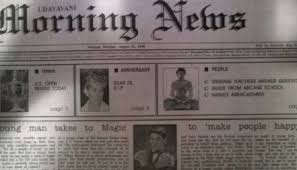
    Young man takes to Magic to ‘make people happy’

    Udayavani Morning News. Manipal, August 31, 1998

    Eyes popping out, mouths agape and with wonderment writ large on their faces they watched with childlike enthusiasm and amazement. “It’s all sleight of hand,” he said brushing off the awe.

    But that is simply hard to believe when he can make a piece of bright pink clock rolled into a Rs 100 note vanish into thin air or make a perfectly strong sturdy pen wobble like it was made of rubber!!

    Welcome to the world of abraca dabra of Nakul Shenoy of Udupi.

    Nakul was one of those kids whose life changed after he attended a magic show of the famous Indian magician P C Sorcar when he was just five years old. The performance fascinated the young boy so much that from that day onwards all he wanted to be was a magician.

    And today at the age of 20, Nakul Shenoy is a proud professional magician. His first performance was in 1994, when he was just 16 years.

    It is to Nakul’s credit that he never tutored under a professional magician but learnt the art by himself reading books on magic and by simply watching magicians perform. David Copperfield and Paul Daniels are his favourite magicians, and hopes that one day he will have the opportunity to watch them perform.

    “Magic as a hobby is an expensive hobby,” says Nakul. “But at the same timeit is also a lucrative one though it has a long way to go in India when compared to the West where magic shows have become very sophisticated, thanks to technology,” he adds.

    Confident and astute, he is the founder of a magic troupe called MAGIQUE – The Majestique Mystique World and also the co-founder of MAADRI which imparts training on magic to young kids.

    And what does Nakul see for himself 10 years from now? “I am interested in doing Journalism and one day I hope to be a free lance columnist. That way I can concentrate on my magic and also get to the people.”

    To Nakul, magic is an art, which he would like to use to create social awareness and fight social evils. His ultimate dream would be to do something for his Motherland and make her proud of him. Here’s to you and your dreams Nakul Shenoy.

    Note: Article reproduced from NAKUL’S ABRACADABRA: Young man takes to Magic to ‘make people happy’ – Udayavani Morning News. (August 31, 1998)